SuperReach uses the last 320 ms of joint motion and commands to infer how a six-axis robot arm is responding. In a simulated MakerMods Metal Arm hold with a 3.0 kg payload, it reduced settled tool-center-point (TCP) error from 27.79 mm with raw PD to 0.28 mm under the same actuator limits.
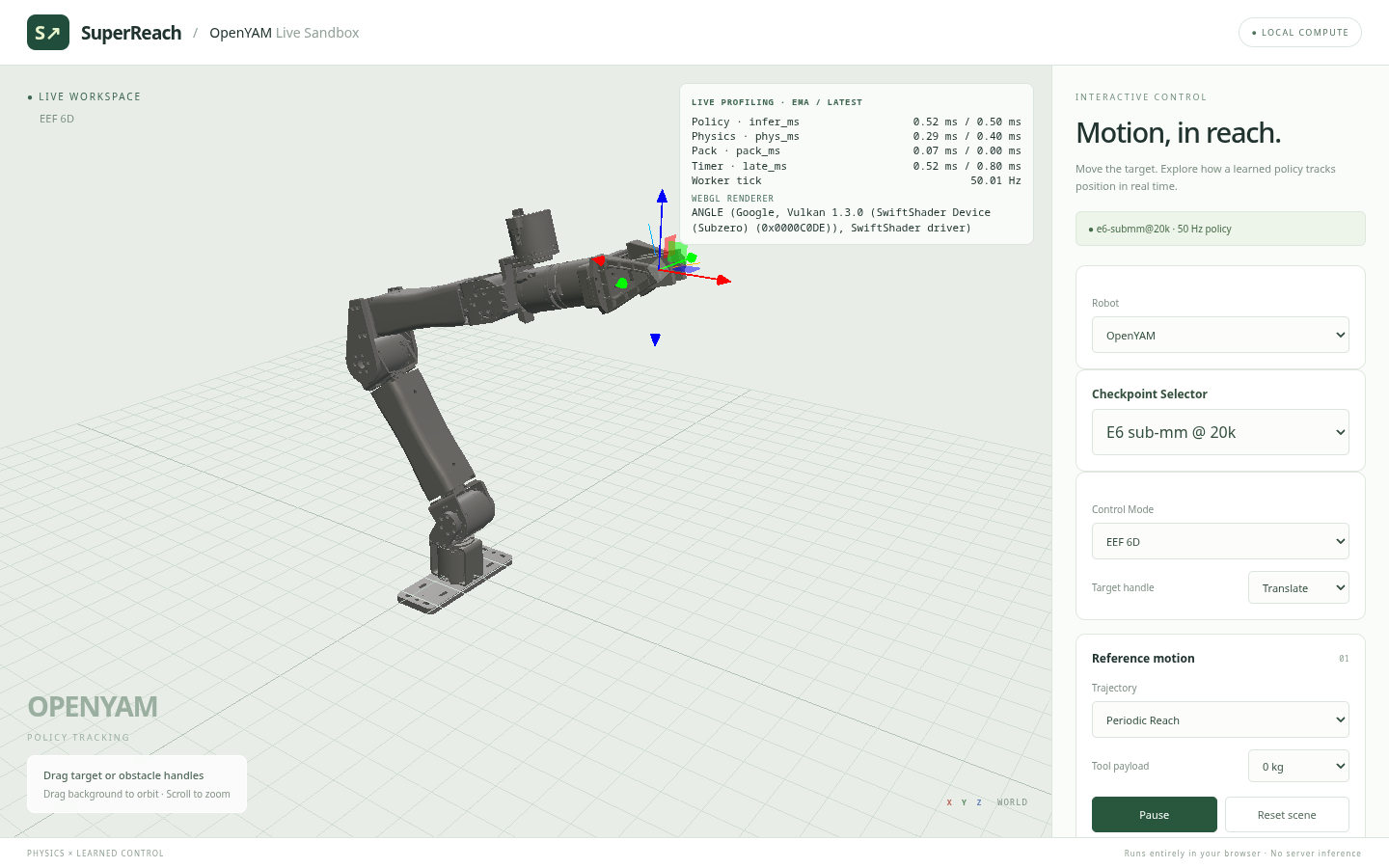
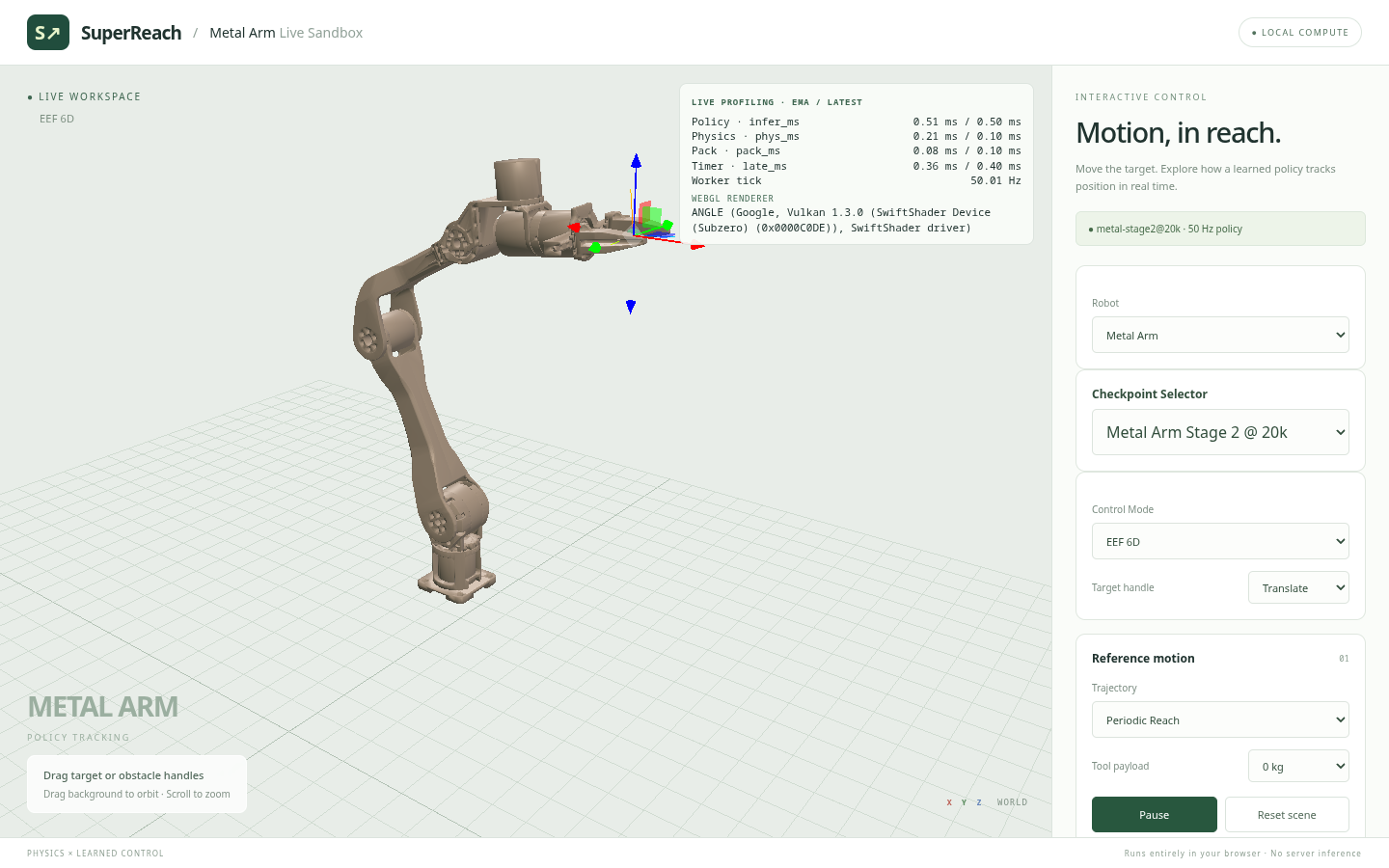
Live sandbox
Run the OpenYAM policy in your browser. The sandbox also includes a Metal Arm checkpoint. Both are simulations, not hardware tests.
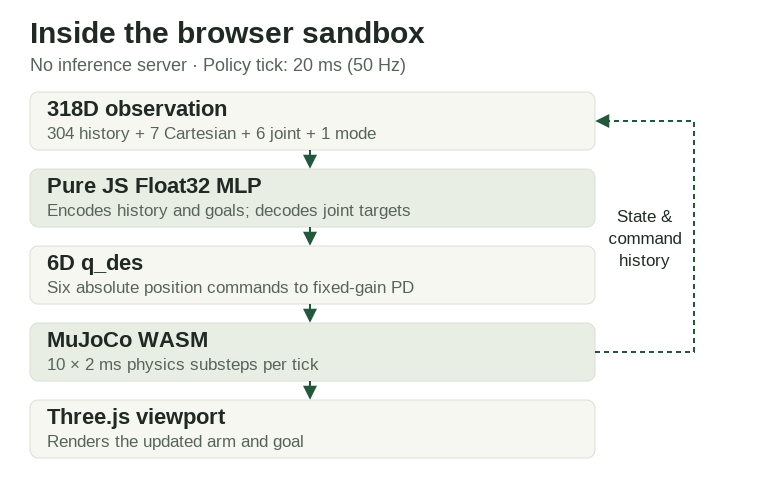
The Hugging Face Space runs the policy and simulated physics locally in the browser, without an inference server.
Why exact joint targets still miss
Analytical inverse kinematics (IK) gives the joint angles that would place the tool at a desired pose in a rigid kinematic model. A proportional-derivative (PD) position servo with finite stiffness needs a position error to generate the torque that holds up an arm against gravity. An unknown payload changes the torque needed to hold position and the inertia the servo must move. Friction, encoder bias, and command delay further change the arm’s response. Even an exact geometric solution can therefore settle short of the target.
Controller design
Online SysID from 16 frames of joint history
A single observation tells the controller where the arm is and how fast it is moving. A short sequence of observations paired with past commands shows how the arm responded. For example, when a wrist picks up a heavier object without a corresponding change in the joint targets, the recent history can show the joints moving away from their commanded positions. Once the arm settles, the history still contains the gap between the measured angles and the commands that are holding them there.
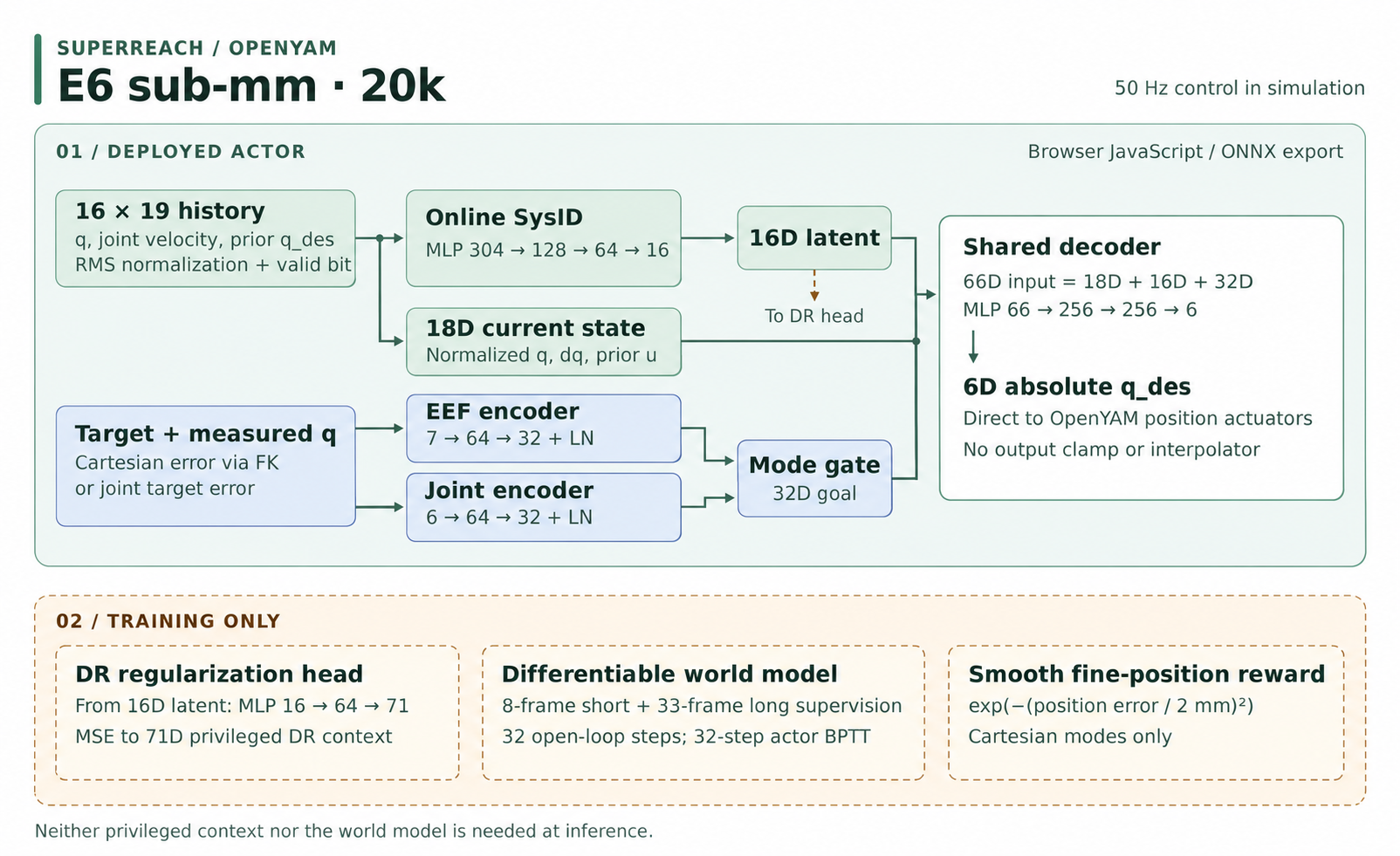
At each 50 Hz tick, the actor reads a causal buffer of 16 frames, representing 320 ms of recent control. Each frame has six measured joint angles, six measured joint velocities, six previously issued q_des values, and one validity bit to distinguish real observations from padding. The actor normalizes the 18 numeric state and command channels with running statistics learned during training. A two-layer history encoder (128 and 64 hidden units) maps the resulting 304 inputs (16 × 19) to a 16-dimensional latent vector. The actor recomputes that vector every tick and uses it along with the current state and goal to choose the next command.
During training, a separate head with 64 hidden units predicts 71 normalized domain-randomization parameters from the latent. A mean-squared error loss weighted at 0.01 encourages it to retain information about payload mass and inertia, link and actuator dynamics, and command delays from 0 to 10 ms. This follows the use of recent proprioception to infer unobserved dynamics in UP-OSI, RMA, and TAM. The deployed actor has no regression head or privileged inputs. It updates the latent from the observed response, without a payload sensor or any online change to the network weights.
Three goal modes in one interface
A vision-language-action model, teleoperation rig, or planner can send whichever goal it already produces: a full tool pose (EEF_6D), a tool position with no requested orientation (XYZ_ONLY), or six joint angles (JOINT_6D). The same interface takes 318 values: 304 history entries, seven Cartesian pose values, six joint targets, and one mode flag.
The actor uses forward kinematics to form Cartesian errors, or subtracts current joint angles from the joint target. The chosen encoder returns a 32-dimensional goal embedding. The shared decoder takes that embedding, the 16-dimensional SysID latent, and the 18 normalized values from the latest frame. Its two 256-unit layers produce six absolute q_des commands for the fixed-gain PD servos, without the reference accumulation used by PolicyIK or heuristic gain scaling. Callers don’t have to wire up a separate IK solver or interpolator.
Reward formulation
The reward focuses on tracking the requested goal, slowing down on approach, and keeping motion and commands smooth. The following terms come from the Stage 1 training code and the Stage 2 recipe, cross-checked against both Metal Arm training stages.
Let S(e; a, b) = 1 − (√(e² + a²) − a) / b. The errors ep, er, and eq are the norms of the TCP position error (m), axis-angle rotation error (rad), and joint-angle error (rad). Here v is joint velocity, u is the issued joint command, and Δ is the change from the previous tick. mean averages over the joints named by the term.
| Stage 1 term | Formula | Where it applies |
|---|---|---|
position | 3.5 × S(ep; .005, .10) or 5.5 × S(ep; .005, .10) | EEF_6D or XYZ_ONLY, respectively |
rotation | 2.0 × S(er; .01, .35) | EEF_6D |
joint_position | 5.5 × S(eq; .01, .35) | JOINT_6D |
approach | −0.8 × ‖(w − w*) / c‖² | All modes, in the active tracking space |
away | −8.0 × max(0, −d·w) | All modes, in the active tracking space |
joint_speed | −0.05 × mean(v²) | All modes |
joint_accel | −0.001 × mean((Δv / dt)²) | All modes |
command_slew | −0.10 × mean((Δu / dt)²) | All modes |
wrist_comfort | −0.05 × mean((q − HOME)²) over the last three joints | XYZ_ONLY |
For approach and away, d is the target-minus-current position vector in TCP or joint space. w is the corresponding velocity relative to the reference during tracking, and the measured velocity otherwise. The desired relative velocity is w* = [d / max(‖d‖, 10⁻⁸)] × c × tanh(3‖d‖ / c), with c = 0.35 m/s for Cartesian modes and 0.75 rad/s for joint mode. This slows the desired approach as the error shrinks. The away term penalizes motion in the opposite direction.
Stage 2 keeps all nine terms and adds position_fine = weight × exp(−(ep / 0.002 m)²). The weight is 1.5 in EEF_6D, 2.0 in XYZ_ONLY, and zero in JOINT_6D. The bonus has no distance threshold or orientation gate. Both stages multiply the sum of the active terms by dt = 0.02 s once per tick.
Training the policy
Following SuperMimic, SuperReach trains a differentiable world model alongside the policy and updates the actor by backpropagating through 32 imagined control steps. Training runs on one RTX 5060 Ti with 4,096 parallel MuJoCo Warp environments in mjlab. After 15,000 Stage 1 updates, Stage 2 runs another 5,000 with the fine-position term. It supervises the world model on a longer window of 33 frames (one initial frame and 32 transitions) alongside the 8-frame pass. Sixteen of the 64 windows in each long batch are sampled for low speed to improve the model near stationary holds. The actor learning rate decays from 5e-5 to 5e-6, while the critic and world model stay at 2e-4.
Results
We evaluated frozen 20k checkpoints in native MuJoCo 3.11.0 on CPU, at 50 Hz with ten 2 ms physics steps per control tick.
Metal Arm: stationary payload holds
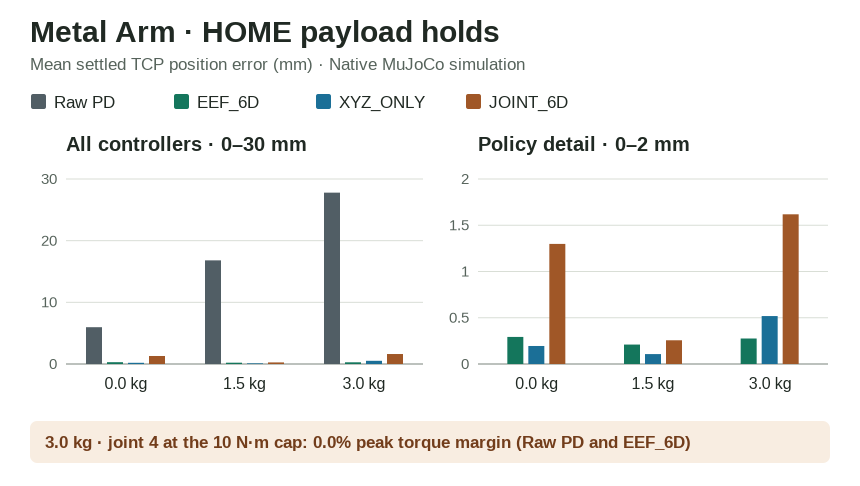
Raw PD and SuperReach started at the requested HOME pose with zero velocity, clean sensors, and identical gains and torque caps. We attached centered rigid payloads at the TCP and averaged TCP error over the final 100 ticks of each six-second run (4.02 to 6.00 s).
| Payload | Raw PD | Stage 2 EEF_6D | Stage 2 XYZ_ONLY | Stage 2 JOINT_6D |
|---|---|---|---|---|
| 0.0 kg | 5.97 mm | 0.29 mm | 0.19 mm | 1.30 mm |
| 1.5 kg | 16.81 mm | 0.21 mm | 0.11 mm | 0.26 mm |
| 3.0 kg | 27.79 mm | 0.28 mm | 0.52 mm | 1.62 mm |
At 3.0 kg, joint 4 reached its simulated 10 N·m peak torque cap with both raw PD and EEF_6D, leaving 0.0% peak torque margin. That load is a simulation test point, not a hardware rating.
OpenYAM and Metal Arm benchmarks
We trained a separate checkpoint for each arm using the same controller architecture. Each recorded 0/129 physical failures across six native suites and three goal modes, where a failure means a sampled joint speed above 100 rad/s. Below are the EEF_6D results; errors are TCP position errors in millimeters.
| Suite | OpenYAM | Metal Arm |
|---|---|---|
| Clean (mean / median) | 12.40 / 4.55 | 8.19 / 0.83 |
| Noisy, 10 ms delay (mean / median) | 14.62 / 5.91 | 10.19 / 2.56 |
| Full hardware randomization (mean / median) | 13.99 / 6.27 | 9.60 / 2.54 |
| Mid-episode payload jump (case mean) | 7.66 | 3.62 |
| Delay-jitter stress (case mean) | 2.58 | 2.71 |
Limitations and next steps
STEP cases score the full motion after a sudden target jump. A few large transit errors pull up suite means more than medians. Excluding STEP, the Metal Arm EEF_6D clean mean drops from 8.19 mm to 0.49 mm. The 15k-to-20k continuation also raised Metal Arm’s long-hold-memory JOINT_6D mean from 38.32 mm to 38.95 mm (+0.63 mm).
Preliminary real-hardware sanity checks are complete. The reported accuracy numbers are from simulation; the next step is controlled hardware benchmarking with external ground-truth tracking.